
One failed audit. One rejected export batch. One gauge that drifted without anyone noticing. That is all it takes for an uncalibrated instrument to turn into a very expensive problem.
If you manage quality, maintenance or procurement in an Egyptian plant, you already know the pressure. Customers ask for traceable certificates. Auditors ask for calibration records. Production asks why the equipment was sent out for two weeks.
This guide explains how calibration services in Egypt work, what the rules require, how often to calibrate, what it costs you when you skip it, and how to choose a laboratory you can trust, whether you operate in Cairo, Alexandria, Giza, 10th of Ramadan City, 6th of October, Port Said, Suez or anywhere else in the country.
What Are Calibration Services?
Calibration is the comparison of your instrument against a more accurate reference standard, under controlled conditions, to find out how far it reads from the true value.
The result is documented in a calibration certificate. That certificate shows the measured error, the uncertainty of the measurement and the reference standards used.
A dedicated calibration laboratory carries out this work under controlled temperature, humidity and vibration conditions.
Calibration does not automatically fix an instrument. It tells you the truth about it. If the error is too large, the device is then adjusted, repaired or retired.
Calibration vs. Verification vs. Adjustment
These three terms are often mixed up, and auditors notice.
- Calibration: measuring and documenting the error against a reference standard.
- Verification: checking whether the instrument meets a defined tolerance (pass or fail).
- Adjustment: changing the instrument so it reads correctly. Always followed by a new calibration.
Why Calibration Services in Egypt Matter for Your Business
Egyptian industry is growing fast in pharmaceuticals, food processing, oil and gas, construction and export manufacturing. Each of these sectors depends on numbers that must be right, which is why measurement calibration in Egypt has become a core part of every quality system.
Here is what unreliable measurement looks like in practice:
- Product quality drift. A temperature probe reading 2 °C low can quietly ruin a food or pharma batch.
- Safety incidents. An inaccurate pressure gauge on a vessel hides a real overpressure condition.
- Audit non-conformities. ISO 9001, GMP and customer audits all ask for evidence of controlled measuring equipment.
- Rejected exports. Overseas buyers increasingly demand traceable measurement records.
- Wasted material. Over-filling, over-processing and rework all start with a bad reading.
A simple scenario shows the cost. A packaging line fills bottles using a scale that has not been checked for two years. If it reads just 1% high, the factory is giving away product on every unit. At scale, the lost material in a year can exceed the cost of calibrating every scale in the plant many times over.
Understanding Traceability, EGAC and ISO/IEC 17025
What Is Metrological Traceability?
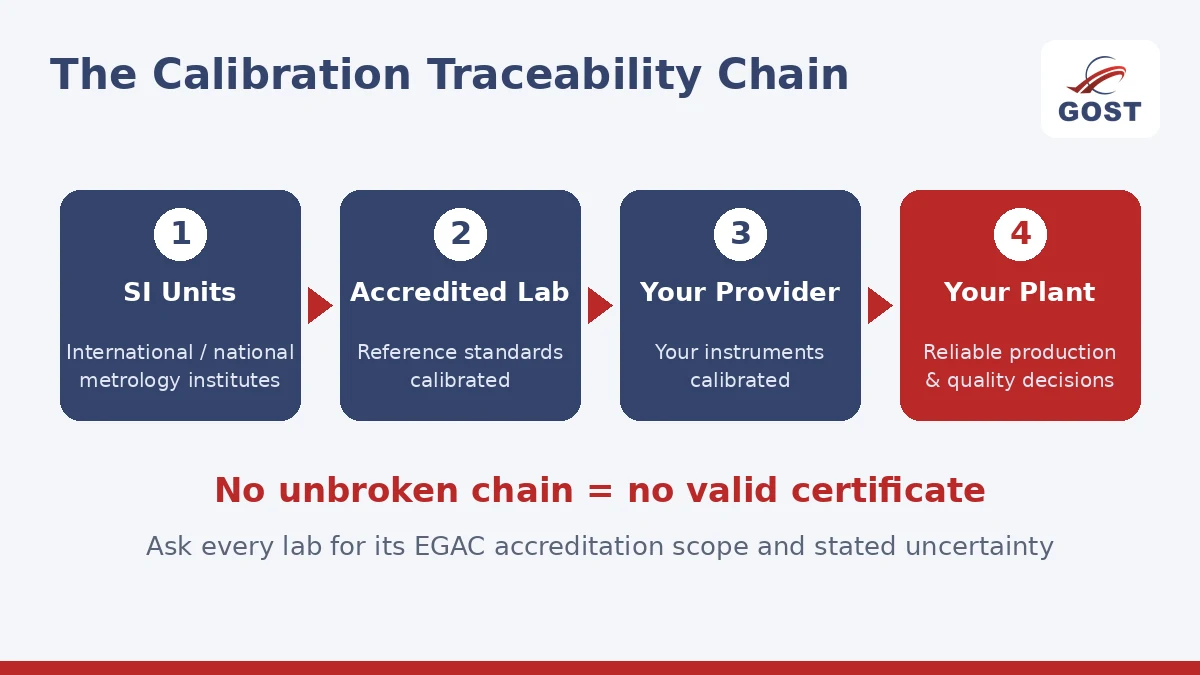
Traceability means your measurement can be linked, step by step, back to the International System of Units (SI) through an unbroken chain of calibrations.
| Level | Who | What they do |
| 1 | International / national metrology institutes | Maintain primary standards for SI units |
| 2 | Accredited calibration laboratories | Calibrate reference standards against national standards |
| 3 | Your calibration provider | Calibrates your working instruments |
| 4 | Your plant | Uses the instruments for production and quality decisions |
If any link is missing, the certificate is just paper.
What Is ISO/IEC 17025:2017?
ISO/IEC 17025:2017 is the international standard that sets the competence requirements for testing and calibration laboratories. It covers personnel, equipment, environmental conditions, methods, uncertainty estimation and impartiality.
A lab that claims to follow ISO 17025 is not the same as a lab that is accredited to it. Accreditation means an independent body has assessed the lab and confirmed its competence for a defined scope.
What Is EGAC Accreditation?
EGAC, the Egyptian Accreditation Council, is the national body that accredits laboratories and inspection bodies in Egypt. An EGAC-accredited calibration lab has been assessed against ISO/IEC 17025 for specific measurement ranges.
That last point matters. Accreditation is scope-specific. A lab may be accredited for pressure and temperature but not for torque or electrical quantities.
How to Check a Lab’s Accreditation Scope
Before you sign, run this quick check:
- Ask for the accreditation certificate and its scope schedule.
- Confirm your parameter and range appear in the scope (for example, pressure 0 to 400 bar).
- Check the certificate is current, not expired.
- Confirm the calibration certificate you will receive carries the accreditation symbol.
- Look for stated measurement uncertainty on sample certificates.
Types of Industrial Calibration Services Available in Egypt
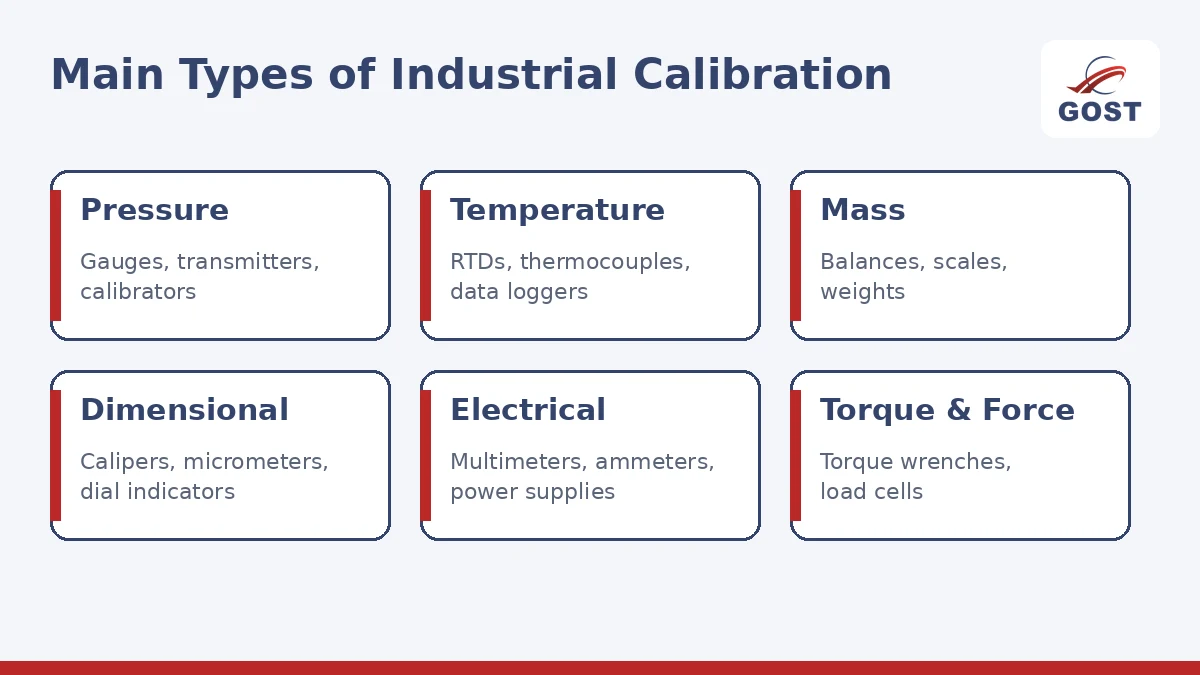
Most Egyptian facilities need several calibration disciplines at the same time. Here are the main ones.
Pressure Calibration
Covers pressure gauges, transmitters, transducers, calibrators, vacuum gauges, pneumatic and hydraulic gauges. It is the most common request within mechanical calibration in refineries, utilities and manufacturing. Pressure instruments are typically checked against standards such as EN 837 and ASME B40.100 for gauges.
Temperature Calibration
Our temperature calibration work covers thermometers, RTDs, thermocouples, dry-block and wet-bath calibrators, data loggers and infrared thermometers. It is critical in pharma, food, cold chain and heat-treatment processes.
Mass and Balance Calibration
Proper balance calibration covers laboratory balances, industrial scales and test weights. Essential for filling, dosing, trade and laboratory work.
Dimensional Calibration
Covers dimensional calibration of calipers, micrometers, dial indicators, depth and height gauges, bore gauges and levels. Used in machining, fabrication and automotive supply chains.
Electrical Calibration
Covers electrical calibration of multimeters, ammeters, voltage and current sources, resistance and capacitance standards, panel meters and power supplies. Relevant to hospitals, power plants and electronics manufacturing.
Force and Torque Calibration
Includes torque wrench calibration plus load cells, tensile and compression machine force systems and hardness testers. Important in construction materials labs and assembly lines.
Other Measurements
Humidity instruments, tachometers, sound level meters, light meters and pH meters complete the typical list.
Quick Reference: Which Standard Applies to What?
| Instrument | Common reference | Typical industries |
| Pressure gauges | EN 837, ASME B40.100 | Oil and gas, utilities, manufacturing |
| Temperature sensors | Reference thermometers, fixed-point and comparison methods | Pharma, food, heat treatment |
| Balances and weights | OIML weight classes | Labs, packaging, retail, trade |
| Dimensional tools | ISO-based gauge block and length standards | Machining, automotive |
| Electrical meters | Calibrated multifunction sources | Hospitals, power, electronics |
| Torque wrenches | ISO 6789 | Assembly, maintenance, construction |
How Often Should You Calibrate? A Practical Framework
There is no single legal interval that applies to every instrument. Intervals should be set by the user based on risk and evidence. Guidance such as ISO 10012 and ILAC-G24 explains how to do this.
Use these five factors:
- Does a wrong reading affect safety, product quality or compliance?
- Manufacturer recommendation. Your starting point for new equipment.
- Usage frequency. Heavily used instruments drift faster.
- Heat, dust, vibration, humidity and corrosive atmospheres shorten stability.
- If the last three calibrations show stable results, the interval can be cautiously extended. If the instrument was found out of tolerance, shorten it.
Starting-Point Intervals
These are common starting points, not rules. Adjust them with your own history.
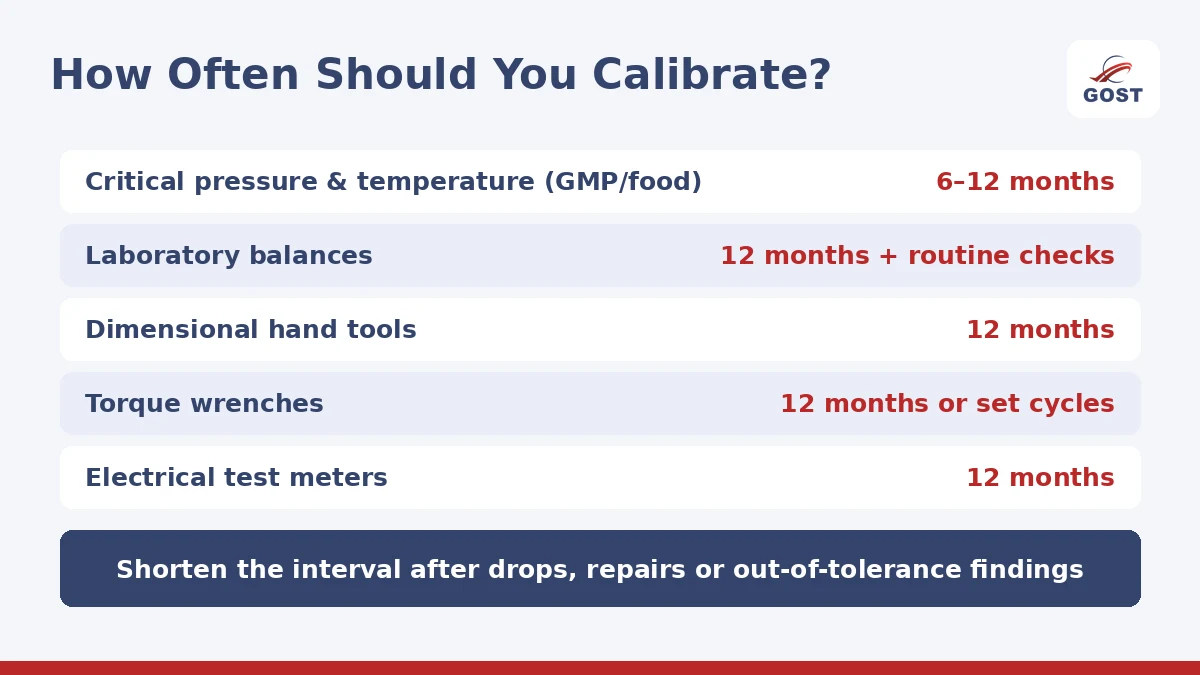
| Instrument type | Typical starting interval |
| Critical process pressure gauges and transmitters | 6 to 12 months |
| Temperature sensors in GMP or food processes | 6 to 12 months |
| Laboratory balances | 12 months (with routine in-house checks) |
| Dimensional hand tools | 12 months |
| Torque wrenches | 12 months or a set number of cycles |
| Electrical test meters | 12 months |
Always calibrate immediately after a drop, overload, repair or any suspicious reading.
On-Site vs. Laboratory Calibration
Both are valid. The right choice depends on the instrument and your downtime tolerance. On-site calibration brings the technician and reference standards to your plant, while lab calibration happens in a controlled environment.
| Factor | On-site calibration | Laboratory calibration |
| Downtime | Minimal, instrument stays in place | Instrument leaves the plant |
| Best for | Installed, large or process-critical equipment | Portable and small instruments |
| Environmental control | Limited by site conditions | Fully controlled |
| Lowest uncertainty | Usually not achievable | Achievable |
| Logistics | Technician travels to you | You ship or deliver |
For factories in industrial zones such as 10th of Ramadan, 6th of October or Borg El Arab, on-site service can save days of transport and production loss. For high-precision reference instruments, the lab is the better choice.
What a Valid Calibration Certificate Must Contain
Do not accept a certificate just because it has a stamp. A proper one includes:
- Unique certificate number and date of calibration
- Identification of the instrument (model, serial number)
- Customer name and location of calibration
- Calibration method or procedure used
- As-found and, where relevant, as-left results
- Reference standards used with traceability
- Environmental conditions during calibration
- Measurement uncertainty for each result
- Name and signature of the authorised person
- Accreditation body symbol and number where applicable
Missing uncertainty values are the most common reason auditors reject a certificate.
Calibration Requirements by Industry in Egypt
Pharmaceutical and Food Production
Auditors expect documented calibration of temperature, pressure, balances and data loggers, linked to qualification and validation work. Many sites combine calibration with temperature mapping and validation of equipment so that one provider covers the whole compliance chain.
Oil and Gas
Pressure, temperature, flow and tank measurements affect both safety and custody transfer. Calibration is usually part of a broader inspection and integrity program for petroleum industries.
Manufacturing and Construction
Dimensional tools, torque wrenches, load cells and electrical meters drive product conformity. Calibration supports manufacturing quality and construction materials testing alike.
Hospitals and Laboratories
Balances, electrical safety testers, temperature units and pipettes need regular traceable calibration to protect patients and results.
How to Choose a Calibration Laboratory in Egypt: 8 Criteria
- EGAC accreditation covering your exact parameters and ranges.
- Stated uncertainty that is small enough for your tolerance (a good rule is a ratio of at least 4:1 between your tolerance and the lab’s uncertainty).
- Turnaround time and whether an expedited option exists.
- On-site capability for installed or heavy equipment.
- Coverage across disciplines, so you do not manage five vendors.
- Certificate clarity, with as-found and as-left data.
- Technical support to interpret out-of-tolerance findings.
- Presence near you, with offices or service coverage in your region.
Red flags include a refusal to share the accreditation scope, certificates with no uncertainty, vague references to “international standards” and pricing that is far below the market.
What Happens When an Instrument Fails Calibration?
An out-of-tolerance result is not a disaster. It is information. Follow this sequence:
- Quarantine the instrument and label it.
- Review the as-found data to see how far off it was.
- Identify every product, batch or measurement made since the last good calibration.
- Assess impact and decide on corrective action (re-test, hold, recall or no action).
- Adjust or repair, then recalibrate.
- Record the outcome and consider shortening the interval.
This impact assessment is exactly what auditors want to see.
Build a Simple Calibration Program in Six Steps
- Inventory every measuring instrument that needs instrument calibration, covering anything that affects quality or safety.
- Classify each as critical, important or non-critical.
- Assign a unique ID and a calibration interval.
- Define acceptance criteria (tolerance) for each instrument.
- Schedule calibrations in a master plan and send reminders.
- Review results every year and adjust intervals using data.
A short staff session on handling and storing instruments also pays off. Training your technicians reduces accidental damage and drift.
Why GOST Egypt for Calibration Services
GOST was established in 2006 in Alexandria and today serves clients from its head office in Alexandria and its Cairo office in Dokki. The GOST laboratory is accredited by EGAC for the calibration of balances, weights, pressure, dimensions, temperature and torque wrenches, along with testing of sound level, light intensity and pH value, supported by our environmental measurements laboratory.
What clients get from GOST calibration services:
- On-site calibration services across industrial sites
- Full calibration reports with test uncertainty values
- Expedited service where deadlines are tight
- Coverage of mechanical, electrical, dimensional and temperature instruments in one place
- Support that connects calibration with qualification, validation and mapping
For teams that also need inspection or consulting, GOST works across quality system consultation, third-party inspection, non-destructive examination and pre-shipment inspection, so your measurement and inspection needs can sit with one trusted partner.
Frequently Asked Questions About Calibration Services in Egypt
What is the difference between calibration and testing?
Calibration measures the error of an instrument against a reference standard. Testing evaluates the properties of a product or material. Both can be accredited under ISO/IEC 17025, but they answer different questions.
Is ISO 17025 calibration mandatory in Egypt?
Not for every business by law. However, ISO 9001 audits, GMP inspections, customer contracts and tenders commonly require traceable calibration, and accredited certificates are the safest evidence.
How much do calibration services cost in Egypt?
Cost depends on the instrument type, range, number of points, accuracy class and whether the work is on-site or in the lab. Volume contracts across many instruments usually lower the cost per item. Request a written quote with scope details.
How long does calibration take?
Simple instruments are often completed in a few working days. Complex or multi-point work takes longer, and expedited service may be available. Plan your schedule so critical instruments never run beyond their due date.
Can you calibrate equipment at my factory?
Yes. On-site calibration is available for installed or large equipment, with the trade-off that uncertainty is usually higher than in a controlled laboratory.
What should I do if my instrument is out of tolerance?
Quarantine it, review the as-found data, assess the impact on products made since the last good calibration, adjust or repair it, and recalibrate.
Do I need to calibrate new instruments?
Yes. A new instrument should have a baseline calibration, since a factory certificate may not match your accuracy needs or may have expired during storage.
Who accredits calibration laboratories in Egypt?
The Egyptian Accreditation Council (EGAC) accredits calibration laboratories against ISO/IEC 17025.
Book Reliable Calibration Services in Egypt with GOST
Your measurements are only as trustworthy as the last calibration behind them.
GOST: For Surveillance & Testing, Calibration and inspection services.
Call or WhatsApp us on +20 106 668 4007, or request a quote today. You can also contact our team in Alexandria or Cairo to plan an on-site visit.
Tell us your instruments, ranges and deadlines, and we will recommend the right calibration plan for your facility.